Lincoln Wheat Cent · Shell Case Penny · 95% Copper · Final Year of WWII

1945 Penny Value, Error list & Coin Identifier App

The coin struck from recycled WWII ammunition shells — a wartime relic hiding in plain sight.

1.49B+

Total Minted

3 Mints

Philadelphia, Denver, S.F.

$20,400

Top Auction Record

7

Error Types

Contents

The 1945 penny occupies a singular place in American coinage history as the last Lincoln Wheat cent struck during World War II — and every single one contains copper recycled from military training ammunition shell casings. These so-called "shell case cents," minted from 1944 through 1946, were the wartime answer to the deeply unpopular 1943 steel penny. The SD Bullion 1945 penny value guide provides current melt values, certified population data, and in-depth variety analysis for Philadelphia, Denver, and San Francisco issues.

1945 Penny at a Glance

  • Composition: 95% copper, 5% zinc (shell case alloy)
  • Weight: 3.11g — plain edge
  • Diameter: 19.05mm — Thickness: 1.52mm
  • Designer: Victor David Brenner (1909)
  • Total mintage: ~1.49 billion across all three mints
  • Color grades: RD (Red) > RB (Red-Brown) > BN (Brown)
  • Mint marks: None = Philadelphia; D = Denver; S = San Francisco
  • Historic note: Final wartime wheat cent; copper from recycled ammo shells

For most collectors, a 1945 penny is a common and affordable coin — circulated examples are worth only a few cents to a dollar, and even gem-quality MS-67 RD examples rarely exceed a few hundred dollars. However, the coin’s unique wartime history, three-mint variety set, and a roster of genuine errors make the 1945 wheat cent a genuinely rewarding series to study and collect. The record auction price of $20,400 for an MS-67+ RD Philadelphia cent underscores how dramatically condition and color can separate values.


Quick Value Check

Three questions to answer before diving deeper

🔴

Check the Mint Mark

Look below the date. No mark = Philadelphia (most common). D = Denver. S = San Francisco (fewest minted — commands a small premium in all grades).

🟡

Examine Under 10x Magnification

Look for doubled mint mark impressions (RPM), raised blobs at the rim (cud die break), or doubling of LIBERTY and the date. Any of these adds real value.

🟢

Grade the Color

Full red-orange luster? MS-65 RD and above is where value accelerates sharply. A single MS-67+ RD sold for $20,400. Brown circulated examples are face value only.

What You See Likely Scenario Estimated Value Next Step
Full red luster, MS-67 or better Top-grade gem ⭐ $500–$20,400 PCGS/NGC certification essential
Double struck / clear two impressions Double Struck Error $100–$500 Authenticate & grade
Raised blob attached to rim Cud Die Break $50–$300+ Size & location determine value
Surface peeling, bubbles, lifting metal Lamination Error $90–$200 Severity determines premium
Design shifted, crescent blank visible Off-Center Strike $25–$300+ Date visible = much higher value
S or D mint mark doubled under 10x Repunched Mint Mark $25–$150 Compare to CONECA reference
Normal copper, worn, any mint Common circulated $0.25–$1 Keep for date / type sets

Varieties & Mintage

Three mints — Philadelphia dominates; San Francisco is the key scarce variety

Variety Mintmark Mintage Rarity Key Notes
1945-P None (Philadelphia) 1,040,515,000 Abundant 2nd largest P mint total in wheat series; MS-67+ RD = $20,400 record
1945-D D (Denver) 266,268,000 Common Desirable in EF+ grade; red uncirculated can fetch $16,000
1945-S S (San Francisco) 181,770,000 Scarcer Fewest minted; small circulated premium; red MS examples up to $7,500

🏭 Why the 1945 Shell Case Cent Matters

In 1943, wartime copper demands forced the U.S. Mint to produce steel pennies coated in zinc — a deeply unpopular move since they rusted quickly and were frequently confused with dimes. The solution was the "shell case cent": from 1944 through 1946, every Lincoln penny was struck from an alloy of 95% copper and 5% zinc, with the copper sourced directly from recovered military training ammunition casings. Every 1945 wheat cent you hold is, quite literally, a piece of American wartime military history pressed into a one-cent coin.


Value by Grade

Standard copper business strikes — error coins priced separately below

Circulated Grades (G-4 to AU-58)

Grade 1945-P 1945-D 1945-S
G-4 (Good)$0.25$0.25$0.50
VG-8 (Very Good)$0.35$0.35$0.65
F-12 (Fine)$0.50$0.50$0.75
VF-20 (Very Fine)$0.75$0.75$1.00
EF-40 (Extremely Fine)$1.00$1.25$2.00
AU-58 (About Uncirculated)$2.00$2.50$4.00

Mint State Grades (MS-60 to MS-67+) — by Color

Grade P — BN P — RD D — RD S — RD
MS-60$1$3$3$4
MS-63$3$8$10$12
MS-65$10$30$35$40
MS-66$25$55$60$65
MS-67$45$200+$220+$180+
MS-67+ RD (Record)$20,400 (P)$16,000 (D)$7,500 (S)

1945 Penny Error List with Pictures

Seven documented error types — from repunched mint marks to dramatic double strikes

The intensive wartime production schedule of 1945 — with dies and presses operating at maximum capacity across three mint facilities — created ideal conditions for minting errors. Equipment fatigue, high-speed striking, and the novel shell-case copper alloy all contributed to a documented roster of error types. For the most current 1945 Penny Value on specific error varieties, professional authentication is recommended for any coin potentially worth $100 or more.

1945 Penny — Error Coin Reference

# Error Type Rarity Circulated MS / Uncirculated
1Obverse Cud Die BreakOccasional$50–$150$150–$300+
2Double StruckRare$100–$200$200–$500
3Clipped PlanchetOccasional$20–$100$100–$200+
4Lamination ErrorUncommon$90–$120$120–$200
5Off-Center StrikeOccasional$25–$75$75–$300+
6BroadstrikeUncommon$50–$100$100–$200
7Repunched Mint Mark (RPM)Uncommon (D & S only)$25–$75$75–$150

Error #1: Obverse Cud Die Break

Die fatigue at the rim creates a raised, featureless blob of metal on the struck coin
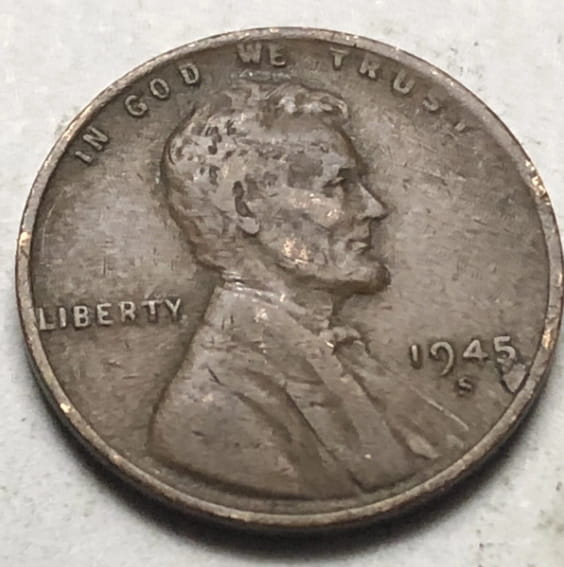
1945 penny cud die break error

1945 Obverse Cud — raised blob attached to rim where die fragment broke away

Cud die break errors result from die fatigue under intensive wartime production schedules. When a piece of the die breaks away at the rim, metal flows freely into that void during striking, creating a raised, flat, detail-free blob on the coin's surface attached to the rim.

How to identify: Look for a raised, flat blob of metal extending inward from the rim • No design detail should appear in the cud area • The most valuable cuds appear on the obverse and affect lettering or Lincoln's portrait • Distinguish from post-mint damage: genuine cuds are always raised, not incused

Value: $50–$150 (circulated) — $150–$300+ (large cud, MS grade)

Error #2: Double Struck

Planchet struck twice with a positional shift between blows — creates overlapping impressions
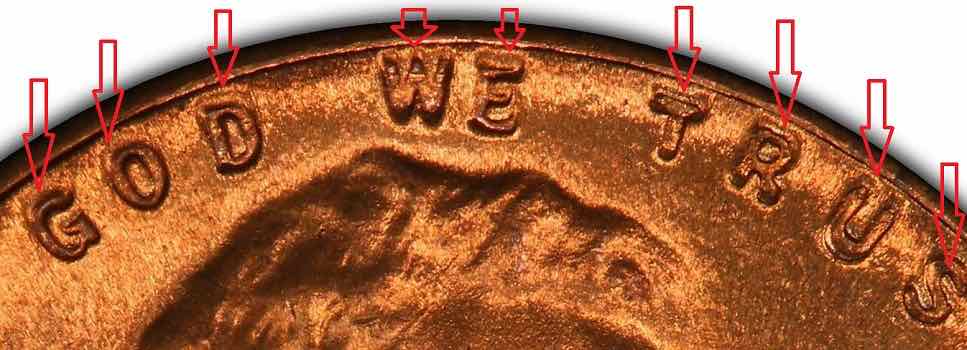
1945 penny double struck error

1945 Double Struck — secondary impression offset from primary, shadow effect on all design elements

Double struck errors occur when a planchet is struck twice with a positional shift between blows. The result is two complete overlapping impressions of the design. During 1945's intense production pace, mechanical malfunctions occasionally caused a struck coin to remain in the press chamber for a second blow.

How to identify: Look for complete duplicate impressions on all design elements — not just lettering • Doubling should show a clear offset shadow effect on Lincoln's portrait, wheat ears, and all inscriptions • Distinguished from doubled die errors (die manufacture issue) by the fact the entire design doubles, including both sides • Coins showing the second strike partially outside the rim are particularly dramatic

Value: $100–$200 (circulated) — $200–$500 (MS, clear separation)

Error #3: Clipped Planchet

Missing curved or straight section from improper blanking — curved clips most common
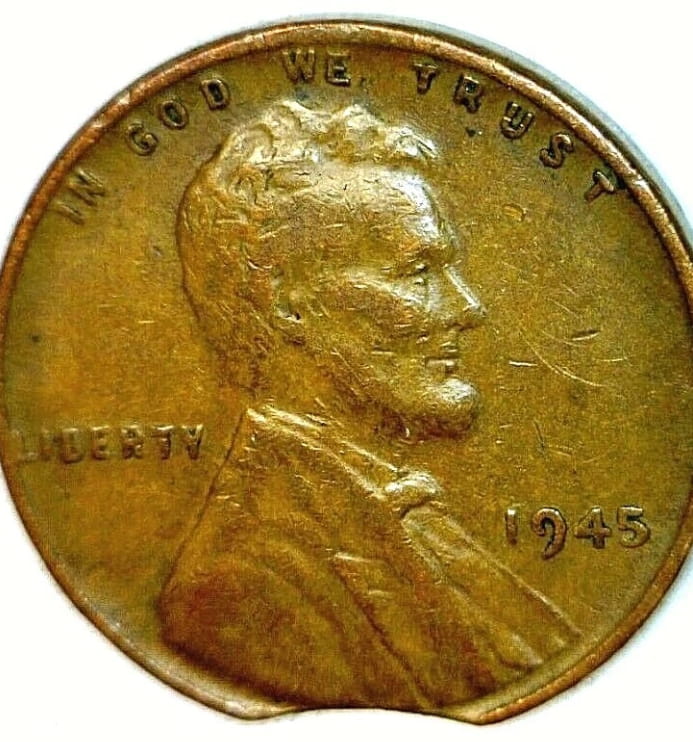
1945 penny clipped planchet error

1945 Clipped Planchet — curved section missing where overlapping blanks were punched

Clipped planchet errors arise when the metal strip is improperly positioned during blanking, causing a planchet to be punched overlapping a previously punched hole (curved clip) or at the strip's edge (straight clip). High wartime production targets increased the likelihood of such quality control lapses.

How to identify: Examine the coin's edge for a missing curved or straight section • Curved clips show a smooth arc; straight clips show a flat edge • Most valuable clips retain the full date and mint mark with 10–25% missing • The rim should be absent at the clip location • 1945-D clipped planchets can exceed $200 in MS grade

Value: $20–$100 (circulated) — $100–$200+ (large clip, date visible, MS)

Error #4: Lamination Error

Metal layers peel or bubble due to impurities in recycled wartime copper alloy
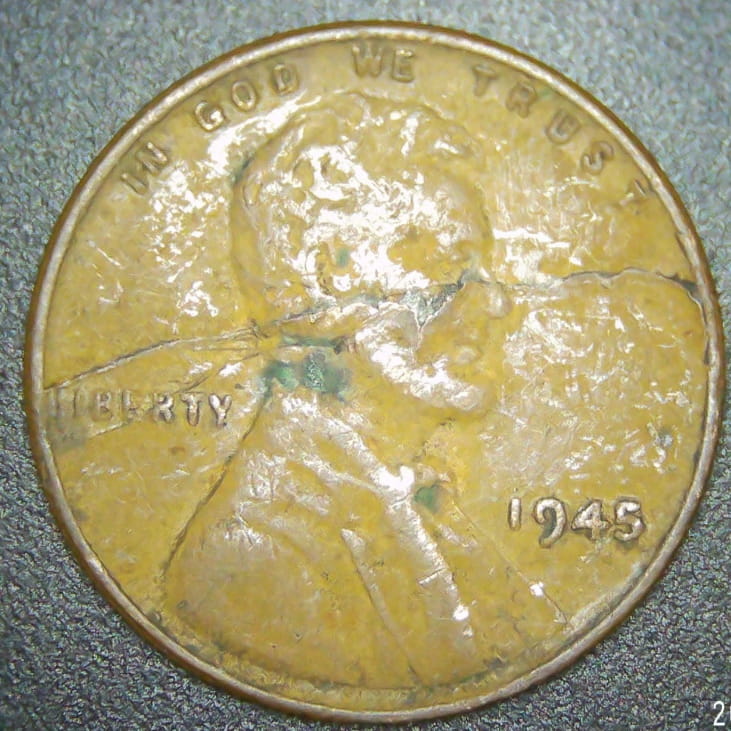
1945 penny lamination error

1945 Lamination Error — surface peeling and bubbling from impurities in shell-case copper

The 1945 penny's shell-case copper alloy — sourced from recycled ammunition casings — made lamination errors especially likely. Impurities or gas pockets trapped during planchet preparation create weak zones where the metal separates into layers over time, resulting in peeling, bubbling, or flaking surfaces.

How to identify: Look for raised bubbles, surface peeling lines, or flaky weak spots on the coin's face • Examine at an angle under good lighting to see raised areas indicating subsurface separation • Genuine lamination shows horizontal, clean separation rather than jagged post-mint corrosion • Retained lamination (flap still attached) is more desirable than a fully separated piece • Most visible on the obverse

Value: $90–$120 (minor) — $120–$200 (dramatic peeling, multiple areas)

Error #5: Off-Center Strike

Misaligned planchet leaves a blank crescent — date visibility is the critical value factor
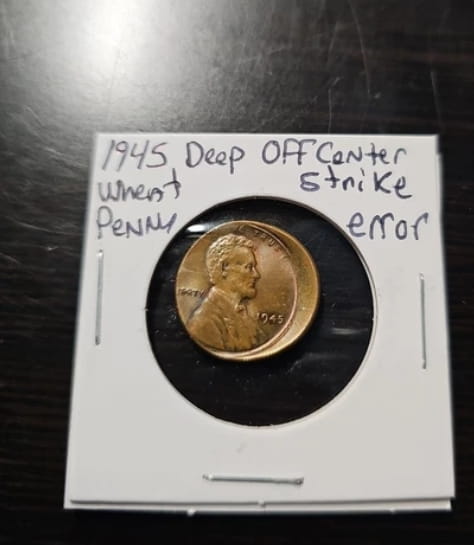
1945 penny off-center strike error

1945 Off-Center Strike — blank crescent visible opposite the shifted design

Off-center strikes occur when a planchet is improperly positioned in the coining chamber at the moment of striking. The feeding mechanisms on high-speed wartime presses occasionally failed, allowing a planchet to shift before the dies came together. A blank crescent appears where the die never contacted the metal.

Value drivers: Date must be fully visible to maximize value • 10–50% offset is the most desirable range • 1945-S off-center strikes command premium prices over Philadelphia examples • Uncirculated examples bring 2–3x the circulated value • Dramatic 50%+ off-center strikes with visible date are the rarest and most valuable

Value: $25–$75 (10–25%) — $150–$300+ (40–50%, date visible, MS)

Error #6: Broadstrike

Struck without retaining collar — metal spreads beyond normal diameter, rim absent
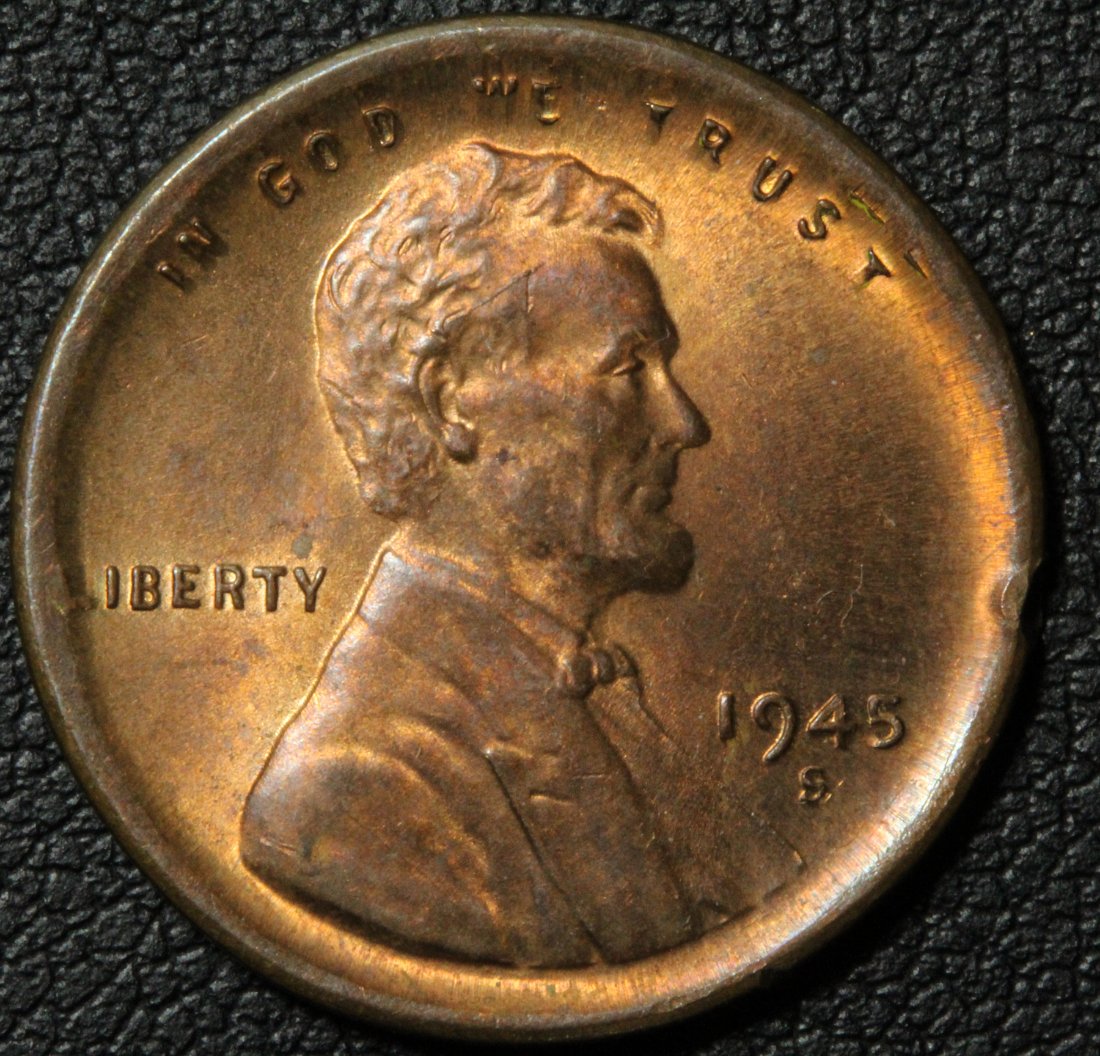
1945 penny broadstrike error

1945 Broadstrike — wider than 19.05mm, no raised rim, design spread outward

Broadstrike errors occur when the retaining collar fails to engage before the dies strike, allowing the copper planchet to spread freely outward under the immense striking pressure. The result is a coin wider than the standard 19.05mm diameter and completely lacking the normal raised rim.

How to identify: Measure the diameter — a genuine broadstrike exceeds 19.05mm, sometimes reaching 20–21mm • The coin will have a plain, undefined edge with no raised rim anywhere • The design appears slightly spread and flattened toward the periphery • Both sides show the same broadstrike characteristics • Distinguish from mechanically flattened coins: genuine broadstrikes show full design detail in the center

Value: $50–$100 (circulated) — $100–$200 (dramatic spread, MS)

Error #7: Repunched Mint Mark (RPM)

Hand-punched D or S applied multiple times in slightly different positions — 1945-D & 1945-S only
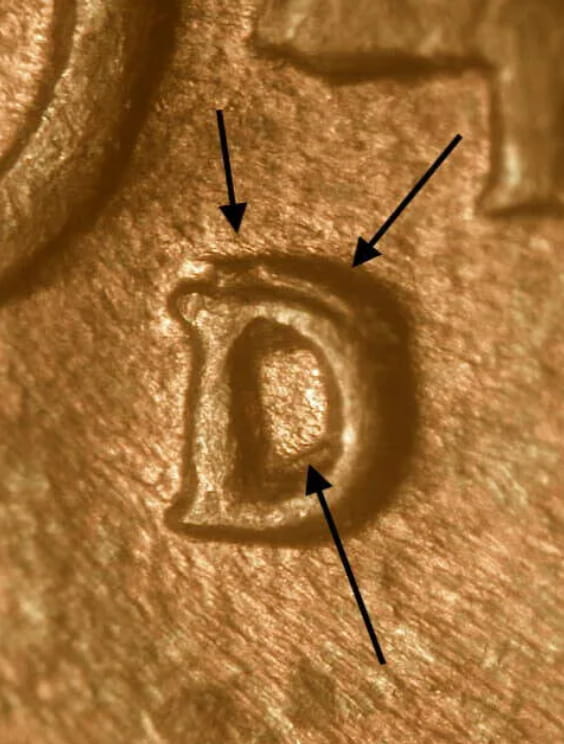
1945 penny repunched mint mark RPM error

1945 RPM — doubled D or S mint mark with visible shadow impressions from earlier punch positions

Before the Mint adopted automated mintmark punching, the D and S marks were hand-punched individually into each working die. This process sometimes required multiple attempts for proper depth or alignment, leaving ghost impressions of earlier punch positions around the final mint mark — the repunched mint mark error.

How to identify: Examine the D or S mint mark under at least 10x magnification • Look for doubling, tripling, or spreading of the letter • Traces of earlier impressions appear as shadows, thickened serifs, or clearly offset secondary marks • Most commonly found on 1945-D and 1945-S varieties • Compare to photos of known RPM varieties for accurate attribution before submitting to PCGS or NGC

Value: $25–$75 (circulated) — $75–$150 (strong, prominent repunching, MS)


Recent Auction Results

Verified public auction records — establishes real market benchmarks

Coin Grade Sale Price Auction House Date
1945-P MS-67+ RDPCGS MS-67+ RD$20,400Heritage Auctions2019
1945-D MS-67 RDPCGS MS-67 RD$16,000Heritage AuctionsEst.
1945-S MS-67+ RDPCGS MS-67+ RD$2,174Heritage Auctions2015
1945-D BN (Genuine)PCGS Genuine BN$5,000eBayDec. 2020
1945-P MS-65 RDPCGS MS-65 RD$30–$55VariousRecent
1945-S Circ. Any GradeAG–AU$0.50–$4Dealer / eBayOngoing
“The 1945 penny is simultaneously one of the most common coins in American circulation and a wartime artifact unlike any other — every one contains copper that once served in the United States military.”

Reality Check & Action Plan

What most 1945 pennies are actually worth — and when to act

Scenario Realistic Value Action
MS-67+ RD, full blazing red$500–$20,000+PCGS/NGC certification essential
Double struck, clear second impression$100–$500Authenticate & grade
Cud die break, large rim area$50–$300+Size and portrait impact drive premium
Lamination, dramatic peeling$90–$200Document severity, consider grading
Off-center 20%+, date visible, MS$75–$300+Authenticate; 1945-S commands premium
MS-65–66 RD, any mint$30–$65Consider grading if full red
Circulated copper, any condition$0.25–$1.00Keep for type / date / mint sets
  1. 1.Never clean your coin. Original surface preservation is everything — cleaning permanently destroys any RD color premium and can reduce a $500 coin to $5.
  2. 2.Weigh error candidates first. A digital scale accurate to 0.01g quickly identifies weight variation errors and wrong-planchet coins before you invest in grading fees.
  3. 3.Check all three mint marks. The 1945-S is always the scarcest — even common circulated grades carry a small but meaningful premium over P and D issues.
  4. 4.Use CoinKnow to attribute before submitting. Identify RPM varieties and error types against a reference database before paying PCGS or NGC fees.
  5. 5.Submit any coin potentially worth $100+ for certification. The cost of slabbing is recovered many times over on genuine error coins and high-grade red examples.

The 1945 penny occupies a unique position in the Lincoln cent story and in American history. Struck during the final months of World War II from copper recycled out of military ammunition shells, it is a genuine wartime relic hiding in plain sight in old coin jars and estate collections across the country. For most collectors, the 1945 is a satisfying and affordable three-variety set — common in circulation, rewarding in gem red condition, and approachable through RPM and die-error variety collecting. The record auction price of $20,400 for a single gem example is a reminder that condition and color, more than rarity, define value in this series.

“The 1945 penny is perhaps the only common coin in American numismatics that carries genuine wartime history in every atom of its copper — a one-cent piece that once flew downrange as part of the defense of the free world.”

Identify Your 1945 Penny with CoinKnow

Detect RPM doubling, die errors, and lamination varieties in seconds

📷

Snap Both Sides

CoinKnow instantly identifies your 1945 variety — Philadelphia, Denver, or San Francisco — and flags error characteristics for immediate investigation.

🔍

Detect Varieties

Automatic detection for RPM secondary mint mark impressions, lamination peeling, off-center strike percentages, and cud die break locations.

💰

Get Instant Value

RD/RB/BN color grading, Sheldon Scale grade within 2 points, and real-time auction comparisons from Heritage and GreatCollections.

Pro Workflow: 1945 Penny Evaluation Steps

1.Identify the mint mark under the date — confirm P (none), D, or S variety first
2.Check D and S mint marks under 10x for secondary impressions (RPM)
3.Scan the rim carefully for raised blobs indicating cud die break errors
4.Weigh the coin: 3.11g = normal; significant deviation warrants authentication
5.Use CoinKnow to match against variety databases before submitting for grading
6.Submit any coin potentially worth $100+ to PCGS or NGC for certification